During his era, Peter McCue was the fastest racehorse and the best sire of Quarter Horses. But did you know that he was registered as a Thoroughbred with The Jockey Club? As with many short horses that were born before the formation of the American Quarter Horse Association, his pedigree was uncertain.
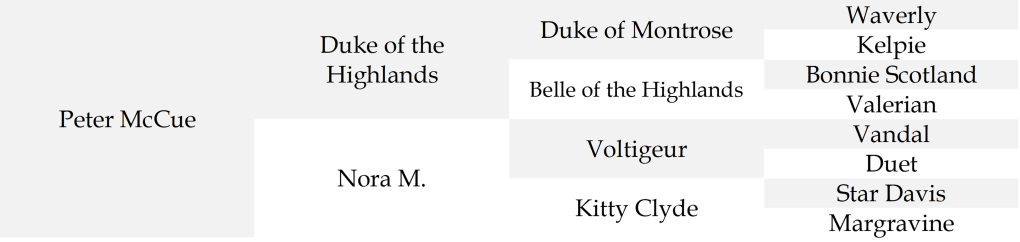
There was never doubt that his dam was Nora M., a bay Thoroughbred mare by Voltigeur and out of Kitty Clyde, by Star Davis. Nora M. was proven on the track. A clipping from a Bloomington, Illinois newspaper states that she won a five-furlong race in New Jersey with ease on August 8th, 1883. After Nora M. joined the broodmare band at Samuel Watkins’ Little Grove Stock Farm, she was recorded as having at least eight Thoroughbred foals – Nola D., Mollie D., Dr. Price, Kate Hamilton, Briggs, Nora C., Hannah D. and Peter McCue. While her foals were reported as having Thoroughbred sires, Watkins also had Quarter Horse stallions on his farm, thus creating a decades’ long controversy.
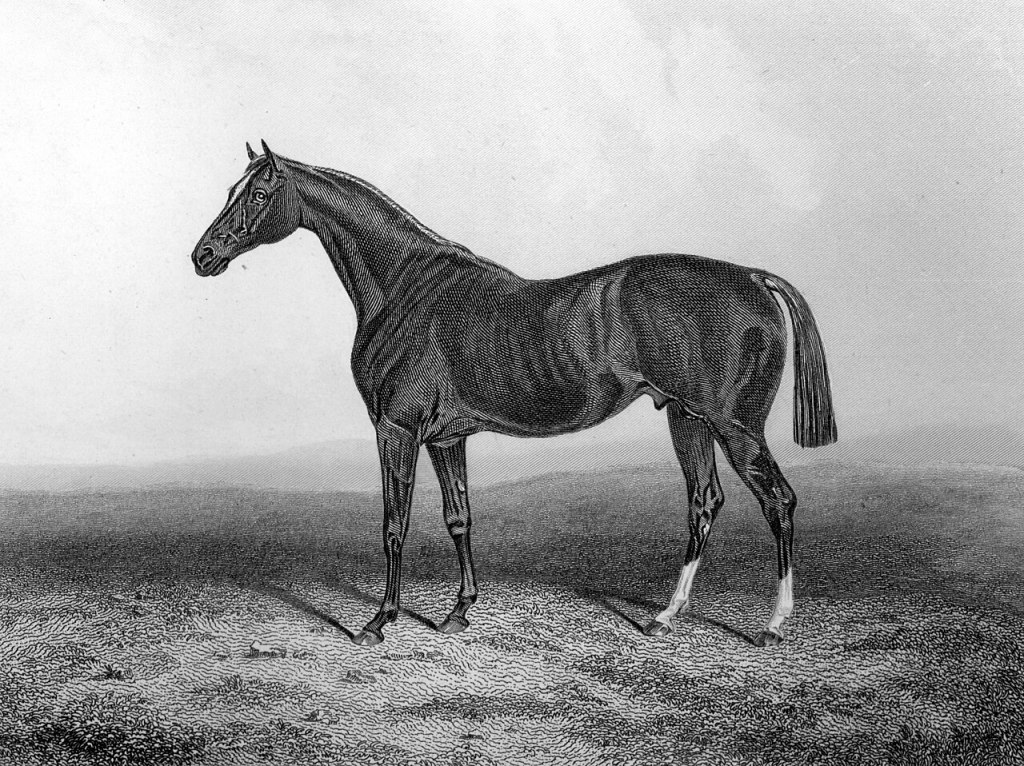
Peter McCue was foaled in Petersburg, Illinois on February 23rd, 1895. He was registered as a Thoroughbred with his sire listed as Duke of the Highlands, one of the Thoroughbred stallions that Watkins owned at that time. Duke of the Highlands had substance, speed, and a stately pedigree. He was by Duke of Montrose and out of Belle of the Highlands, by Bonnie Scotland, one of the greatest sires of nineteenth century running horses. Bonnie Scotland was imported from England. His son Luke Blackburn was inducted into the Hall of Fame. Bramble, another son of Bonnie Scotland, sired Kentucky Derby winner Ben Brush who later became a leading sire in North America. Male-line descendants of Ben Brush include Broomstick, Sweep, and Ariel, one of the best Thoroughbred sires of Quarter Horses during the 1930s and ‘40s.
“To me it seems highly likely that the Duke actually was Peter’s father,” wrote Craig Phillips, one of Peter McCue’s jockeys, in the March 1949 issue of Western Horseman. “Considering Peter McCue’s splendid record of performance, both on the track and in the stud, I am willing to accept his parents as registered.” However, Phillips was one of very few horsemen who felt that way.
Today, AQHA asserts that Peter McCue was not sired by Duke of the Highlands, but by Dan Tucker, a Quarter Horse stallion that was bred by Watkins and stood at Little Grove Stock Farm. Dan Tucker was by Barney Owens and out of Butt Cut, by Jack Traveler. His second dam, June Bug, was a Thoroughbred mare by Harry Bluff, the sire of the legendary Steel Dust. Although Dan Tucker had an average race record of running, and often losing, mostly mile-long races, he was said to have had near-perfect conformation which made him a sought-after sire.

Peter McCue was a dark bay, like Dan Tucker, but he also shared characteristics with Duke of the Highlands. Regardless of which stallion was his sire, Peter’s pedigree would have been predominately Thoroughbred with multiple crosses to greats such as Glencoe, Sir Archy and Whip. Because he was registered as a Thoroughbred, Peter McCue was able to enter races at sanctioned race meets. As a two-year-old, he won eight recognized races at distances from 4 to 4 ½ furlongs. At age three, he was said to have run the quarter in 21 seconds. Peter won 22 of the 30 official starts that he made as a three- and four-year-old. He also ran numerous times on the bullpen tracks of the fair circuit. Unfortunately, the heavy use caught up to Peter. He was forced to retire when he strained a tendon and broke his left front pastern.
Peter stood in Illinois for several years and was later sold to Texas and then to Oklahoma, and finally to Colorado. He sired great horses everywhere he went. He was bred to numerous Thoroughbred mares and the resulting foals were registered as such and raced in recognized races, just as Peter had done. His sons A. D. Reed, Buck Thomas, Chief, Harmon Baker, Hickory Bill, Jack McCue, John Wilkins and Sheik were all prolific sires. His daughters were also exceptional producers.
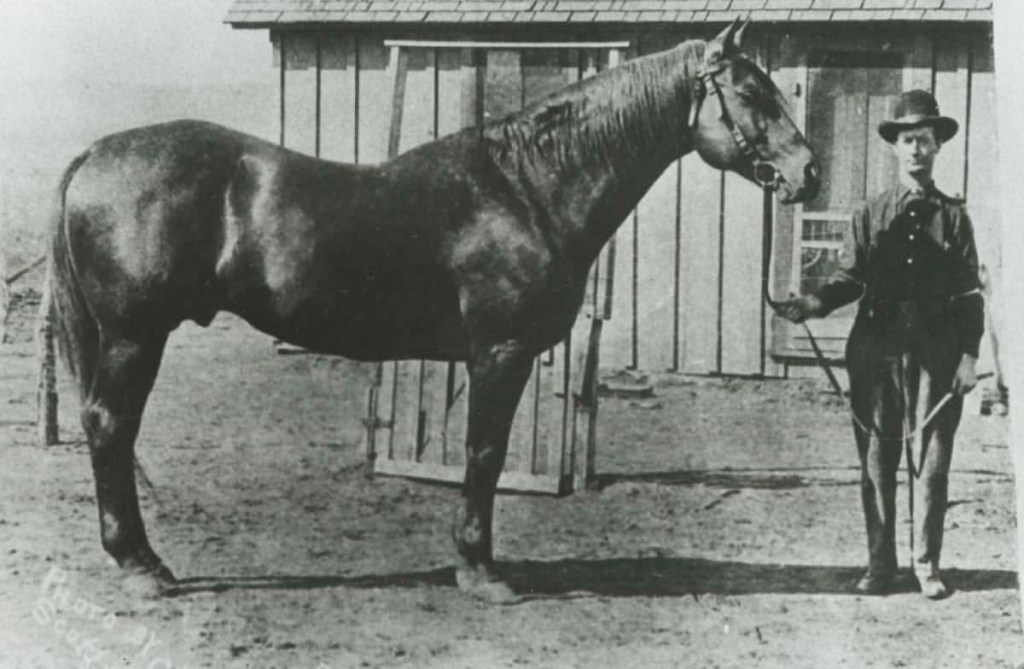
In 1923, Peter McCue died at the age of 28. Nearly twenty after his death, on December 16th, 1942, an affidavit was signed in Oklahoma stating that Dan Tucker was Peter’s sire. There were motives to make either claim about the horse’s parentage. At the time of his registration, Thoroughbred papers would have allowed Peter McCue to enter higher-paying races. At the time of the affidavit, the newly formed AQHA would have benefited from officially stating that Peter McCue, the greatest sire of short horses, was not a Thoroughbred, but a Quarter Horse. Basically, the affidavit could have been a publicity stunt.
Whether Peter McCue was all Thoroughbred or only three-quarters is a mystery that matters little. The fact that people are still arguing about it today, one hundred years after his death, is a testament to the horse that he must have been. One fact that cannot be disputed is that Peter McCue was a great horse.
Sources: Equineline, Western Horseman, All Breed Database

 The Western Thoroughbred