Miss Bank was foaled in June of 1940 in Sierra Blanca, Texas. Joe O’Keefe is recorded as her breeder in Legends 4: Outstanding Quarter Horse Stallions, which was published by Western Horseman Magazine in 1999. According to Champions of the Quarter Track, a book written by Nelson C. Nye and published in 1950, Ross Perner was the breeder of Miss Bank. Both sources list her sire as Captains Courageous, a U. S. Army Remount Service stallion. Captains Courageous was by multiple stakes winner Stimulus and out of Sea Dream, an imported daughter of the British stallion Lemonora. Captains Courageous was unplaced in three starts. Although he was an unsuccessful racehorse, he became well-known by stockmen in Texas as a sire of cow horses. Captains Courageous sired at least seventeen AQHA registered foals, including Superior Cutting horse Miss Choya. He also sired AQHA Racing Register of Merit-earners Bo Cue Blanc and CB. His best son, Rey, sired 139 registered Quarter Horse foals, including Frontera Sugar, the dam of Sugar Bars, and Reina Rey, the dam of Lightning Rey.

Apron Strings, the dam of Miss Bank, was a quarter-type mare that was used as a polo mount. Dr. Goodman, her owner, claimed that she was the best in his string of sixteen horses. The pedigree of Apron Strings is somewhat mysterious. AQHA has no official record of her sire or dam. By some accounts, Apron Strings was by Brown Joe, a son of Joe Hancock. Other records indicate that Apron Strings was a Thoroughbred that was registered with The Jockey Club with Apprehension as her sire and Mammys Girl as her dam. If those records are correct, that would mean that Miss Bank was entirely Thoroughbred. Of course, her true parentage is likely unknowable now, but even if she was only half Thoroughbred, her story is worth sharing.
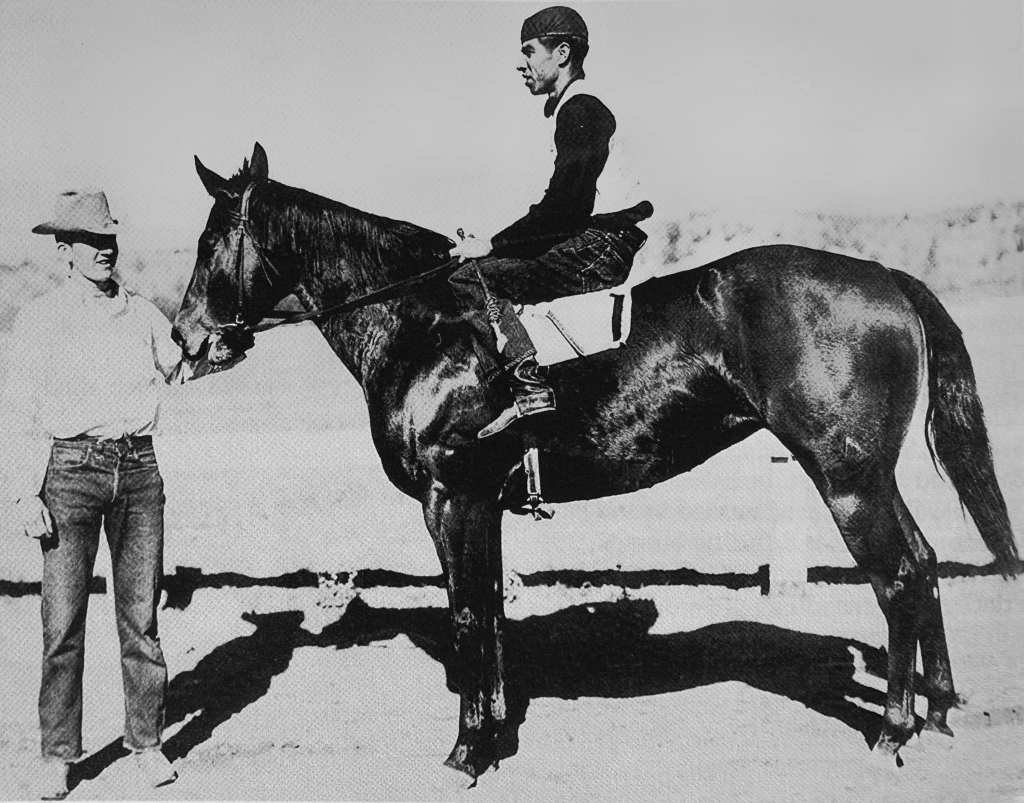
Miss Bank passed through the hands of several owners by the time she was three. That certainly contributed to the confusion regarding her breeding and parentage. According to Nye’s version of events, she was purchased from the Perner Ranch by Mr. Plunk Fields as a yearling. Whether or not that is true, all accounts have her showing up at a bush track meet in Alamogordo, New Mexico in 1943. She was under the ownership of Leon Gillespie, owner of The Old Bank Club in El Paso, Texas. At that time, the bay filly was not yet named. Gillespie was told by track officials that she needed a name to be eligible to race. He allegedly chuckled and said, “just call her Miss Bank,” and that is what they did. Miss Bank won a 350-yard race by a half-length that day.
Records of her early racing career are somewhat sparse, but when Miss Bank was five, Gillespie turned her training over to his son, Bob Gillespie, and her jockeying to his nephew, Chuck Ward. She reportedly started seventeen times for the young cousins and won every race. She defeated some of the top sprinters of the day including Queenie, Piggin String, Miss Panama, Senor Bill, Prissy Vandy, Tonta Gal, Barbra B, Hard Twist and Lady Lee. At some point, she ran three match races in one day. “Roy Rice of Fabens, Texas, matched a horse at her for a race to be run over a course of 350 yards at El Paso’s old Sheriff’s Posse Corral,” Nye wrote. “Miss Bank won this race by a quarter of a length. Some three-quarters of an hour later she ran the same horse again over the identical course, this time defeating him by daylight. In less than an hour after this second race they were matched once again. In each race, Miss Bank was the victor by a greater margin; these races were run for $50 a piece.”

In 1946, Miss Bank won the New Mexico State Fair Championship and the Rillito World Championship, both at 440 yards. On December 13th of that year, Miss Bank was matched against Shue Fly. The two great mares ran two races at two distances – 320 and 350 yards. Miss Bank was victorious both times. The following year, Miss Bank ran one of the greatest races of her career in the New Mexico Championship Quarter at Albuquerque. With Bob Burris as her trainer and Frankie Figueroa in the irons, Miss Bank carried 129 pounds, which was at least four pounds more than any of her eleven rivals. She was behind at the start but ended up winning by a neck over B Seven, Squaw H, Lucky Manners, Shu Baby, Bay Annie, Byglo and others. The recorded time of 22 seconds flat was a new world record. Unfortunately, although the race was fairly run, it was not timed in accordance with A.Q.R.A. regulations and her time was not recognized.
Shortly after that race, Miss Bank was sold to D. V. Land of El Paso, Texas. She later sold again to Jim Derrick of Carlsbad, New Mexico. In the later years of her career, she won the Tucson Speed Stakes and Silver City Championship Stakes. “Although ten years old at this time,” Nye wrote in Champions of the Quarter Tracks, “she is perfectly sound and has never suffered a serious mishap. She is a solid bay, longer than tall, showing her Thoroughbred blood to a marked degree. She is very fine-boned and breedy, has a powerful forearm, stifle, and gaskin, a beautiful head, and speed to spare… Her many trainers have spoken highly of her fine disposition. She is always a contender at every distance and runs every time as though determined to win… She has raced in all parts of the country under all manner of conditions and has never refused any legitimate challenge.”

By 1950, her racing career was nearing its end. Art Pollard, a racehorse breeder from Tucson, paid Derrick $7,500 for Miss Bank to add her to his famed broodmare band. Her final race record showed 60 official starts, 29 wins, 14 seconds and 5 thirds, with $60 in earnings. Her unofficial wins and earnings were likely much higher than that. At one time or another during her dominant tours of the quarter circuits, Miss Bank held or equaled the track, association or world records at 220, 300, 330, 350, and 440 yards. She was indisputably one of the greatest mares to have ever graced the short tracks when she entered her well-deserved retirement.
As a broodmare, Miss Bank was also great. Her first foal, Bankette, was foaled on December 26th, 1952. She went unraced due to that late birthdate, but she was a noteworthy producer. Bankette was the dam of six ROM earners, including Rebel Cause, the 1961 World Champion Three-Year-Old Colt and 1962 World Champion Aged Stallion. His offspring earned over $2.7 million on the track.

Her second foal, Deserette, was by the Thoroughbred stallion Texon Boy. That means that like her mother Miss Bank, Desertette may have also been entirely Thoroughbred. Desertette won one race and earned a Racing ROM. She produced three ROM earners – Johnny Breeze, Sizzlin Sally and So Gay Bar.
Her third foal, Fantasy, was by Pollard’s stallion Lightning Bar. Fantasy placed third in the 1957 Bardella Handicap and earned a racing ROM. Fantasy produced two ROM-earners, Fantacia and Chicks Fantasy. Fantacia became an AQHA Champion after she set a new track record and won grand champion at halter. Lightning Bank, a full brother to Fantasy, was foaled in 1958. He earned a racing ROM and went on to sire 121 AQHA registered foals. They included ROM-earners Bank Charge, Bank Light, Sportsmobile and Flying Bankroll.

In 1960, Miss Bank gave birth to her final foal, Manor Orphan. The chestnut filly was given that name because shortly after she was born, there was outbreak of colitis on Pollard’s ranch that claimed the lives of Miss Bank, Lightning Bar, Hula Girl P, and several others. Years later, Pollard still felt the sadness of losing those great horses. He treasured the memory of Miss Bank defeating Shue Fly. “There were not a lot of horses who could do that to Shue Fly,” Pollard told Western Horseman. “But then, Miss Bank was a shade better than a lot of horses.”
Sources: Equineline, Equibase, American Quarter Horse Association, Western Horseman, Champions of the Quarter Tracks

 The Western Thoroughbred